Whenever someone asks how TrackAsia operates its map system, they usually expect a grand answer: dozens of architectural layers, a jungle of the latest technologies, and endlessly complex diagrams. That is the familiar picture of a "big system."
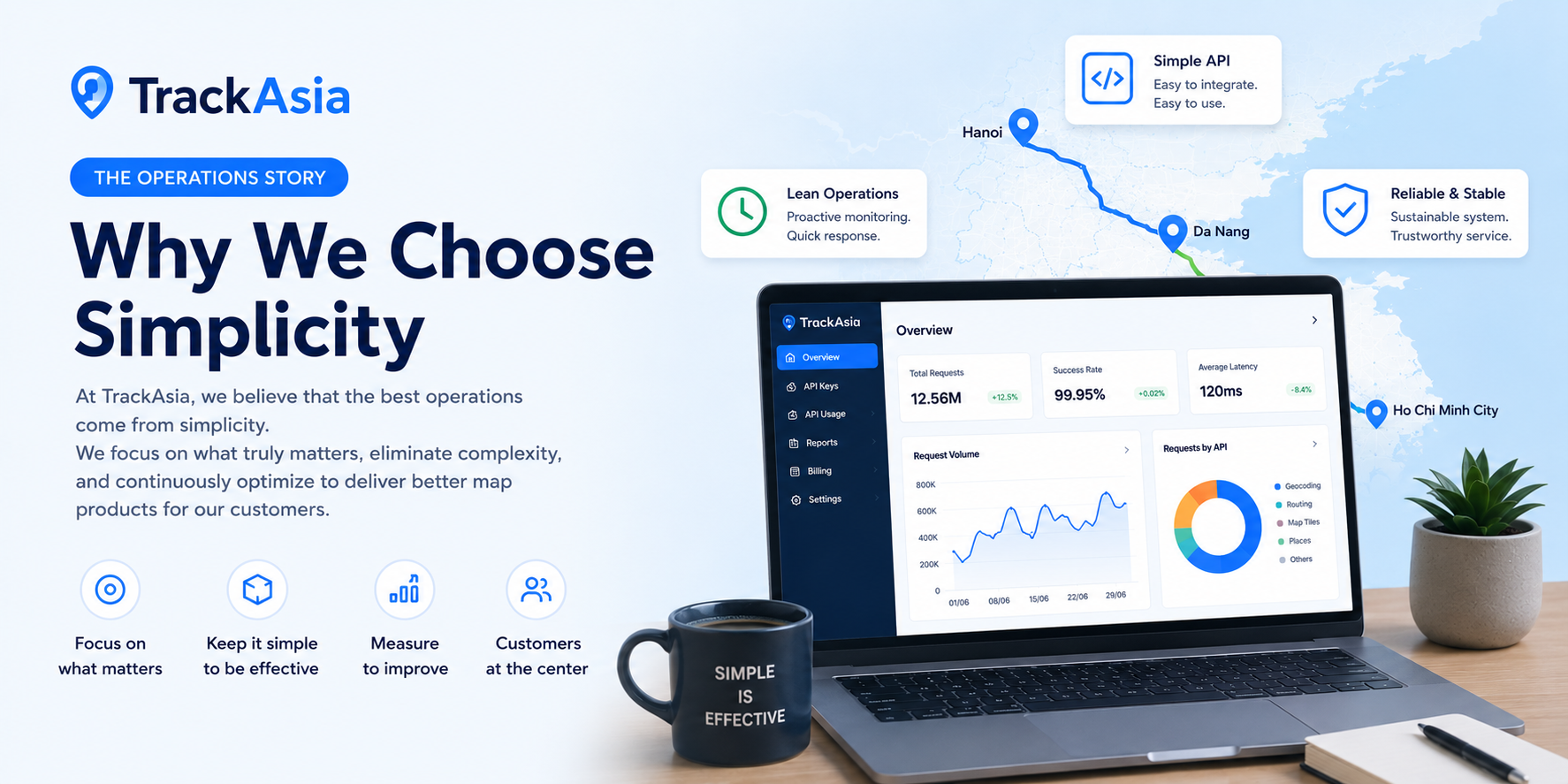
But our real answer goes in the completely opposite direction. If we had to summarize TrackAsia's operational philosophy in one sentence, it would be: make the system as simple as possible — and keep it that way.
This is not a marketing slogan. It is a core engineering decision, and it directly explains why TrackAsia can operate reliably at a fraction of the typical market cost.
Summary: TrackAsia processes millions of map queries every day. We achieve this not by stacking more technology, but by removing what isn't needed. A system with fewer components breaks less, is easier to fix, cheaper to operate — and scales more gracefully when the time comes.
There is an uncomfortable truth in software engineering: most systems don't fail because they lack features — they fail because they become too complex to maintain.
Every new technology added, every intermediary layer built, introduces one more thing that can break at 2 AM, one more thing a new engineer will spend weeks trying to understand, and one more hidden cost quietly eating into the monthly budget. Many long-running platforms carry enormous operating expenses not because they do more, but because they are feeding a machine that even they struggle to control.
"Every engineer loves adding new tech to a system. Very few have the discipline to remove things. At TrackAsia, our default question isn't 'what should we add?' — it's 'what can we take away?'"
We chose the harder, more disciplined path: every time we face an architectural decision, the first question is always, "Do we truly need this?" If the answer is not a clear "yes," the answer is "no."
There is a widespread misconception: simplicity means being basic or half-baked. The reality is the exact opposite. The simplicity TrackAsia pursues is the result of a rigorous filtering process — knowing what not to build is just as important as knowing what to build.
Every team's resources are finite: time, people, money. The question is never how much you have, but where you direct it. Many platforms make the mistake of spreading themselves thin across dozens of secondary features and technology layers, ending up with nothing that is truly excellent.
TrackAsia follows a principle of focus: all resources go into the core of what customers actually need, and everything outside that is cut away without hesitation.
This focus creates a compounding effect: the core product keeps getting sharper, while costs are never inflated by unnecessary extras. Customers get exactly what they pay for — nothing more, nothing less — and they never have to subsidize complexity they will never use.
At its core, a map platform needs to solve three problems: storing spatial data, searching addresses, and calculating routes. We built our system tightly around those three things and nothing more.
We use tools that have been proven globally over many years for storing and querying geographic data, rather than reinventing the wheel or chasing unstable new tech. Vietnam's map data is built on top of open-source OpenStreetMap, which we process and normalize to match the realities of local addresses.
This is where we invest the most effort, because it is what customers experience directly. An address lookup or route calculation must return a result almost instantly. We optimize relentlessly to make these operations fast and trustworthy — not to show off which technology runs underneath.
The principle throughout: each component owns exactly one responsibility and does it extremely well. When something needs fixing or upgrading, we touch only that part, without fear of bringing down everything else. That is a freedom a tangled system can never have.
TrackAsia currently processes millions of queries every day. Hearing that number, many assume we must have a massive server farm crunching data around the clock. The reality is the opposite.
The secret to handling large loads isn't computing faster — it's not recomputing what has already been computed.
Good infrastructure is boring — it runs so consistently that people forget it exists at all. That is the goal.
Instead of chasing sophisticated operational techniques just to "look professional," we focus on the fundamentals and execute them with care:
If there is one area where we pour the most genuine effort, it is not infrastructure — it is data and the uniquely challenging problem of Vietnamese addresses.
Addresses in Vietnam present a puzzle that no international technology solves out of the box: homes deep inside alleyways, address numbers like "88/55/12," an endlessly variable shorthand culture, and most recently, sweeping changes to district and commune names following administrative mergers. A map API is only truly useful when it understands these very "Vietnamese" realities.
This is where we choose to invest, rather than spending money on inflating infrastructure. To us, the value of a domestic map platform doesn't lie in how "international" it is — it lies in how well it serves the actual operational reality on the ground in Vietnam.
Engineering talk may sound abstract, but this philosophy of simplicity translates directly into tangible value for our customers:
We don't build a complex system to look "premium." We build a system that is good enough, and simple enough, so you never have to pay for complexity you don't need.
Behind TrackAsia is not a showcase of enterprise technology. It is a disciplined choice: keep the system simple and stable, stay tightly focused on the real map problems of Vietnam, and as a result, operate at low cost while remaining genuinely reliable.
If your business needs a map platform that runs quietly, understands Vietnamese addresses, and doesn't blow up your budget, give TrackAsia a try. Simplicity, it turns out, is the hardest thing to build — and we have already done that work for you.
This article was shared by the TrackAsia team — the digital map platform built for Vietnamese businesses.
Moving this industry forward requires not only skill, talent and expertise, but also imagination. From all of us.

 Vietnamese