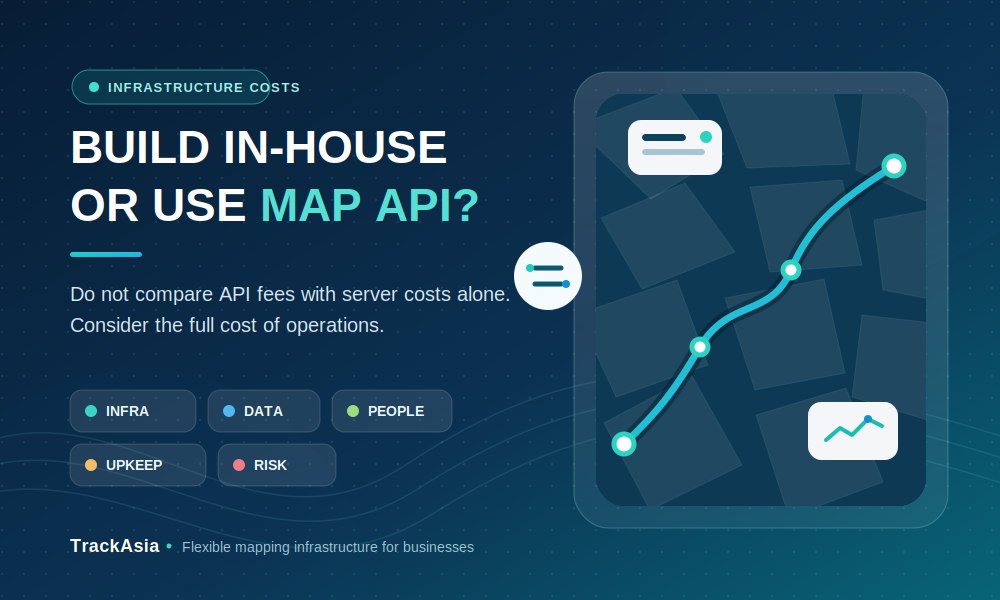
Running an in-house platform can provide greater control. A Map API can shorten deployment time and reduce the technical burden. But comparing an API bill with server rental alone leaves out some of the largest costs: people, data, operations, and risk.
As mapping requirements grow, many businesses face a choice: continue using a Map API or build their own platform with open data and open-source software. On paper, the comparison seems simple. One option charges per request, while the other requires servers but carries no fee for each query.
In practice, these two models cannot be compared through a single cost line. A business mapping platform includes more than a basemap. It may need place search, geocoding, directions, distance matrices, data updates, performance monitoring, backups, and incident response.
Businesses therefore need to look beyond which option appears cheaper today. Usage volume, team capability, and the role of maps in daily operations determine which approach has the more reasonable total cost of ownership.
Building in-house does not mean creating all road data from scratch. Businesses commonly use open data such as OpenStreetMap together with open-source components to deploy private services. Data and software, however, are only the raw materials. Turning them into a stable production platform still requires substantial work.
The work begins with data: downloading it, importing it into a database, building indexes, and keeping it synchronized. Next come the services the application actually needs, which may include basemaps, address search, geocoding, reverse geocoding, directions, or distance matrices.
Once the platform is running, the workload shifts to servers, storage, bandwidth, caching, load balancing, and backups. The operations team must monitor latency, error rates, capacity, and update processes while upgrading software, applying security patches, and checking compatibility.
Real-world data is often the harder part. Addresses may be incomplete, use former names or abbreviations, or point to the wrong location. A route can also be technically correct while remaining unsuitable for the way a business operates.
Worth remembering: open-source software may carry no license fee, but a production platform built from it still requires infrastructure, data, staff, and on-call responsibility.
With a Map API, a business is buying more than the right to send requests. Much of the value comes from having a platform ready to use: data has been processed, services have been deployed, capacity can scale, errors are monitored, and infrastructure is maintained.
Depending on the plan, API fees often cover query infrastructure, scaling capacity, data updates, and maintenance of the underlying services. Businesses may also receive tools for managing keys, quotas, analytics, and alerts, along with integration documentation and incident support.
In other words, the monthly fee transfers part of the technical workload to the provider. The product team must still manage how the application uses the APIs, but it does not have to maintain the entire platform behind them.
The trade-off is a degree of dependence on the provider's pricing policies, terms of use, data formats, and service availability. Using an API is therefore not a reason to ignore architecture. The integration should remain simple enough to control request volume and support future changes.
This is one of the most common budgeting errors. A Map API bill is a clear monthly figure. The cost of running an in-house platform is spread across cloud resources, staffing, development time, on-call work, and data operations. If API fees are compared only with server costs, the in-house option will almost always look cheaper than it really is.
| Cost area | Build and operate in-house | Use a Map API |
|---|---|---|
| Initial investment | Research, infrastructure setup, data import, optimization, and testing. | API integration and adjustments to the interface and business workflows. |
| Recurring infrastructure | Servers, storage, bandwidth, backups, redundancy, and monitoring. | Usually included in service fees or usage plans. |
| Specialized staff | Requires backend, DevOps, spatial database, and data-processing expertise. | Mainly requires integration, usage management, and output quality checks. |
| Data updates | The business builds and maintains its own update process. | The provider is responsible for the data supplied through the service. |
| Incidents and on-call operations | The business detects, diagnoses, and recovers from incidents. | Responsibility is shared with the provider within the service scope. |
| Level of control | High, with deep customization possible when the required expertise is available. | Depends on the API scope, contract, and integration design. |
For a fair comparison, businesses should evaluate both options over the same period, such as the expected product lifecycle, rather than looking only at the first three months. The budget can then be divided into two groups.
At the beginning, a business must allocate resources to select technologies, design the architecture, and establish development, testing, and production environments. Data must be imported, indexed, and checked before the platform connects to the existing application. The system also needs load, security, redundancy, and recovery testing before it supports real operations.
After launch, cloud resources, bandwidth, and data storage continue to generate costs. The technical team must monitor the platform, maintain the data-update pipeline, upgrade software, and handle incidents. Queries may also need further optimization as volume or geographic coverage changes.
The business must preserve internal knowledge through documentation, training, and handovers. Redundant capacity for peak periods or failures is also part of the budget, even if much of it remains unused during normal operations.
A Map API usually requires less initial investment, but its cost changes with usage. An in-house platform generally has higher startup and fixed costs, while its marginal cost per request may fall once volume is large enough. A break-even calculation is useful only when people and risk are fully included.
An in-house platform needs people who understand how it works. If that knowledge sits with only one or two engineers, the business creates another form of internal dependency. Recovery may take longer when the person responsible leaves, moves to another project, or is unavailable during an incident.
Staffing costs should include recruitment, training, documentation, on-call work, and knowledge transfer. The technical team must also keep up with changes to open-source software, operating systems, databases, and related libraries.
This does not mean that building in-house is always the wrong choice. It makes sense when mapping is a capability the business needs to control over the long term, the right team is available, and the company is prepared to maintain operational ownership rather than simply avoid an API bill.
Opportunity cost is difficult to see, but it can have a large effect on the decision. Time spent repairing data pipelines, tuning routing servers, or fixing map errors cannot be spent improving the core product.
When considering an in-house platform, businesses should assess whether mapping provides a direct competitive advantage or simply supports the main product. If a specialist provider can operate the map platform while the internal team brings an important feature to market sooner, that saved time has economic value.
Delays and outages should be evaluated in the same way. In many cases, the damage from one week of platform problems may exceed the savings generated by operating it in-house.
Opportunity cost does not appear on a cloud invoice. It appears in product delays, slower customer response, and core work that remains unfinished.
Businesses can begin with a simple formula and then add figures that reflect their operating environment:
Mapping TCO = Implementation + Infrastructure or API fees + Operations staff + Data and updates + Monitoring and redundancy + Incident response + Opportunity cost + Migration cost
For a meaningful comparison, both options must use the same assumptions for users, orders, and request volume. The functional scope must also match, including basemaps, search, geocoding, and directions.
Requirements for response time, availability, redundancy, geographic coverage, and update frequency must be evaluated on the same basis. The calculation should then cover current usage, expected growth, and peak demand.
A comparison has little value if one option includes only a minimum server configuration while the other includes a full SLA, support, and redundancy.
Building in-house is more suitable when maps and location data directly differentiate the product, or when the business needs customization that standard APIs cannot provide. Large, stable traffic volumes can also make dedicated infrastructure more efficient.
Operational capability is the other requirement. The business needs suitable GIS, backend, and DevOps expertise, especially when internal data, on-premises deployment, or tight control over data flows is required. The maintenance budget must remain available over the long term, even as responsible staff change.
When these conditions are in place, control and customization may be worth more than faster initial deployment.
A Map API is often the simpler choice when a business needs to launch quickly, has a small technical team, or cannot yet predict traffic. During market validation, investing too early in a private map platform can distract the team without delivering a proportional return.
This approach also makes sense when maps are important but do not need to become an internally operated core capability, and the provider's standard functions meet most requirements. Service commitments, support, and predictable costs make planning easier.
The main benefit is that the technical team can focus on the company's own product instead of maintaining infrastructure that does not create a meaningful difference.
Many businesses do not need to build everything or outsource everything. A hybrid model can keep the data and logic that create differentiation in-house while using managed services for components that demand substantial operational work.
For example, a business can manage its warehouse data, delivery points, and service areas while a provider supplies basemaps and geocoding. Verified addresses can be stored to reduce repeated queries while ordinary traffic continues through the Map API.
A small integration layer can standardize data between the application and provider. For a specialized requirement, the business may operate one function internally while continuing to use managed services for standard functions.
The integration layer should not become a complex platform of its own. It only needs to be clear enough to control data, measure usage, and replace individual components when a real need arises.
| Situation | Approach to evaluate first | What to check |
|---|---|---|
| New product with uncertain traffic | Map API | Costs under growth scenarios and the ability to change plans. |
| Business with proprietary data but limited GIS staff | Hybrid model | Data ownership, integration method, and support scope. |
| Mapping is a core capability and needs deep customization | In-house or hybrid | Team capability, maintenance plan, and time to break even. |
| Stable demand and standard functions | Map API | SLA, data quality, total request volume, and technical support. |
| Private deployment or strict data-control requirements | In-house, private cloud, or a specialized service | Data boundaries, operational responsibility, and redundancy. |
TrackAsia provides Map API infrastructure built on the open mapping ecosystem for businesses that need basemaps, place search, geocoding, and directions in Vietnam. Product teams gain the benefits of open data and open-source technology without taking on all the work of deploying, updating, and monitoring the underlying infrastructure.
Depending on their requirements, businesses can use TrackAsia APIs or discuss a deployment model that better fits their data and operational needs. This approach helps keep the architecture simple, reduce maintenance work, protect operational data, and maintain a 99.9% service level.
For systems currently using proprietary platforms, reviewing traffic and integration design may also reveal opportunities to reduce API costs by 50–70%, depending on the functions, scale, and actual usage pattern.
Building in-house provides control, but it also creates long-term responsibility for data, infrastructure, and people. A Map API speeds up deployment and reduces operational work, but businesses must manage usage costs and avoid becoming too dependent on one provider.
No single option is right for every business. A sound decision is based on total cost of ownership, the team's actual capabilities, and the value mapping infrastructure creates for core operations, rather than the price of one request or one server.
TrackAsia can work with your technical team to review requirements, traffic, and overlooked costs, then build suitable scenarios for your mapping platform.
TrackAsia — Flexible mapping infrastructure for businesses in Vietnam.
Moving this industry forward requires not only skill, talent and expertise, but also imagination. From all of us.

 Vietnamese