
An attractive price list may help a business reduce costs when signing a contract. In day-to-day operations, however, the total cost of a Map API also depends on how the application generates requests, the quality of the returned data, the effort required to handle exceptions, and the ability to scale as transaction volume grows.
When comparing map providers, businesses often begin with a reasonable question: how much do 1,000 API calls cost? The number is easy to understand, enter into a spreadsheet, and present in a budget plan.
The problem is that one order does not necessarily generate just one API call. A single address search may trigger several autocomplete requests. An existing address may be geocoded again whenever a new order is created. A tracking screen may reload a map or recalculate a route several times without the user noticing.
A low unit price therefore matters only when the business can control the total number of calls, the quality of the results, and the associated operating costs.
The Map API charge shown on an invoice is generally based on usage across services such as map display, place search, geocoding, directions, and distance matrix calculations. This is only the most visible part of the cost.
The actual total cost may also include:
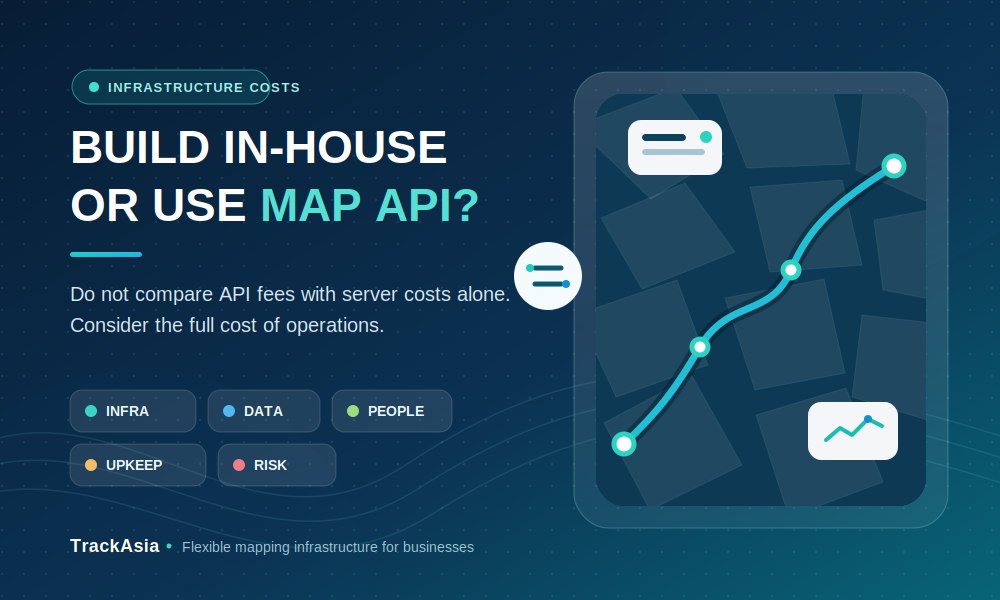
A more useful perspective: do not ask only, “How much do 1,000 calls cost?” Ask, “How many API calls and operational exceptions does the business need to handle to complete 1,000 orders?”
The number of Map API calls rarely corresponds directly to the number of users or orders. It depends on how the product is designed.
If the application sends a request after every character, an address such as “125 Nguyen Van Linh” may generate many queries before the user selects a result. A suitable debounce interval, minimum character count, and geographic search boundary can substantially reduce unnecessary calls.
A regular customer may place many orders for the same destination. If the system geocodes the address for every order instead of reusing verified coordinates, the business is paying repeatedly for the same data.
A minor interface update does not always require a new directions or distance matrix request. If application logic does not manage state properly, costs can increase without producing any improvement in operational quality.
A successful API response does not necessarily mean that an address has been interpreted correctly. In Vietnam, users may enter abbreviated street names, familiar local landmarks, former administrative names, or incomplete district information.
If an incorrect location is still passed into route planning, the resulting cost does not appear on the Map API invoice. It appears elsewhere:
When testing a provider, businesses should therefore use their own real-world address data rather than a few popular locations. The match rate, house-level accuracy, suitability for the operating area, and number of cases requiring manual correction should all be measured.
A new application may operate comfortably within a free allowance or the first pricing tier. As the numbers of orders, drivers, and internal users increase, the true cost structure begins to emerge.
Before choosing a service, a business should model at least three scenarios:
| Scenario | What to assess | Commonly overlooked risk |
|---|---|---|
| Current operations | Average traffic, peak hours, and error rates | Estimating by user count instead of actual API calls |
| Expected growth | Two to five times the volume and the corresponding pricing tiers | Reduced discounts or changes to usage terms |
| Peak period or event | Capacity, quotas, and response times | Being rate-limited precisely when map services matter most |
This calculation helps a business understand the cost of succeeding at scale instead of optimizing only for a pilot deployment.
A service with a low unit price but unclear documentation, inconsistent responses, or limited troubleshooting visibility may require much more engineering time to integrate and maintain.
Practical questions to ask include:
Engineering time and downtime are both real costs, even when they do not appear in the map provider's quotation.
A business does not need an overly complex financial model. It can begin with a simple formula:
Total mapping cost = API fees + Integration and maintenance costs + Exception-handling costs + Downtime costs + Migration costs
To establish inputs for this formula, businesses should measure:
Providers should then be compared using the same dataset, business workflow, and growth scenarios. This prevents decisions from being based on two price lists that do not reflect the same operating conditions.
A low price remains an important advantage when it comes with the right conditions:
In other words, good pricing creates sustainable savings only when it is part of a well-designed and well-operated system.
TrackAsia provides map infrastructure for businesses that need map display, place search, geocoding, and directions in Vietnam. TrackAsia's approach is not simply to replace one price list with another. It is to help businesses examine their real traffic and understand how Map APIs are being used within their products.
Depending on scale and usage patterns, businesses can substantially optimize API costs compared with proprietary platforms while maintaining a 99.9% SLA, reducing infrastructure maintenance overhead, and protecting the privacy of operational data.
The greatest value does not come from making a single API call cheaper. It comes from predictable budgets, stable operations, and the freedom to adapt as requirements change.
TrackAsia can help your business review its Map API workflows, identify redundant requests, and build cost scenarios based on real transaction volumes.
TrackAsia — Flexible map infrastructure for businesses in Vietnam.
Moving this industry forward requires not only skill, talent and expertise, but also imagination. From all of us.


 Vietnamese