Low-code and automation have become popular choices for Vietnamese startups during the MVP stage, thanks to their ability to shorten development time and reduce initial engineering costs. In most business models related to delivery, logistics, or location-based services, Maps APIs are almost an indispensable component.
However, once systems begin operating with real data and real orders, many teams realize that integrating Maps APIs in a low-code environment carries significant risks—particularly around cost, stability, and the ability to handle Vietnam-specific address structures.
This article analyzes several “blind spots” that are often overlooked in the early stages but have a direct impact on scalability and operational efficiency as startups grow.
At the early stage, most startups do not have a large enough engineering team to design a well-structured system from the outset. The top priority is shipping a product quickly to validate market demand (PMF), with optimization considered later.
Common approaches include:
In this context, Maps APIs play a foundational role in many core operations: address geocoding, distance calculation, driver assignment, and delivery fee calculation. The most familiar choice is often Google Maps API.
In practice, startups rarely use Maps APIs to build end-user map experiences. Most API usage happens in the backend, supporting operational decisions such as:
These operations are usually bundled into one or several automation workflows. When the system is small, everything runs smoothly. Problems only begin to surface as processing volume increases.
Consider a common scenario for an urban delivery startup.
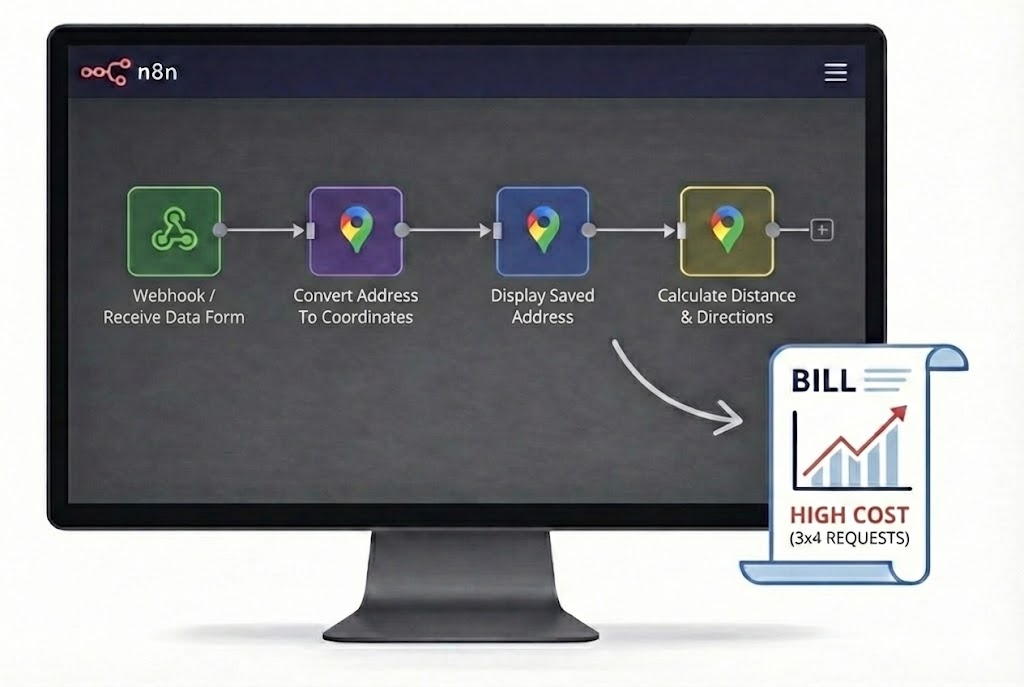
A typical order-processing workflow built on a low-code platform includes:
From a business perspective, this workflow makes sense. From a system perspective, however, each order triggers multiple consecutive API calls.
During early testing with a few dozen orders per day, costs are negligible. But once the system reaches around 800–1,000 orders per day, the total number of map-related requests can easily reach several thousand per day. This is often the point where founders realize operating costs are growing much faster than expected—even though the business model itself has not changed.
One Ho Chi Minh City–based delivery startup at the MVP stage used n8n combined with Google Maps APIs for its entire address-processing workflow. On average, the system handled 700–900 orders per day, with each order generating 3–4 map API requests for geocoding, normalization, and distance calculation.
According to feedback from a customer already familiar with TrackAsia, after about six weeks of real-world operation, Maps API costs accounted for roughly 18–22% of total infrastructure costs—despite stable order volume and an unchanged business model.
In this case, the system remained stable and did not experience major technical failures. The issue lay in the original workflow design: address-processing steps were separated, with no mechanism for data reuse, causing API calls to scale linearly with order volume as the system grew.
APIs Are Powerful, but Not Low-Code Friendly
Global Maps APIs are designed for multiple markets and a wide range of use cases, which means they come with numerous parameters and configuration options.
In low-code environments—where each configuration is handled through a visual interface—understanding and controlling the impact of these parameters becomes difficult. As a result, workflows may produce inconsistent outputs, especially when input data is not standardized.
One reality many startups only discover during real-world operations is that Vietnamese addresses are often descriptive rather than standardized.
Descriptions such as “inside an alley,” “opposite a school,” or “near the market” are easy for humans to understand but difficult for APIs built around international address standards to process accurately.
In large cities like Ho Chi Minh City, it is common for addresses to be syntactically valid yet incorrect in terms of actual delivery drop-off points.
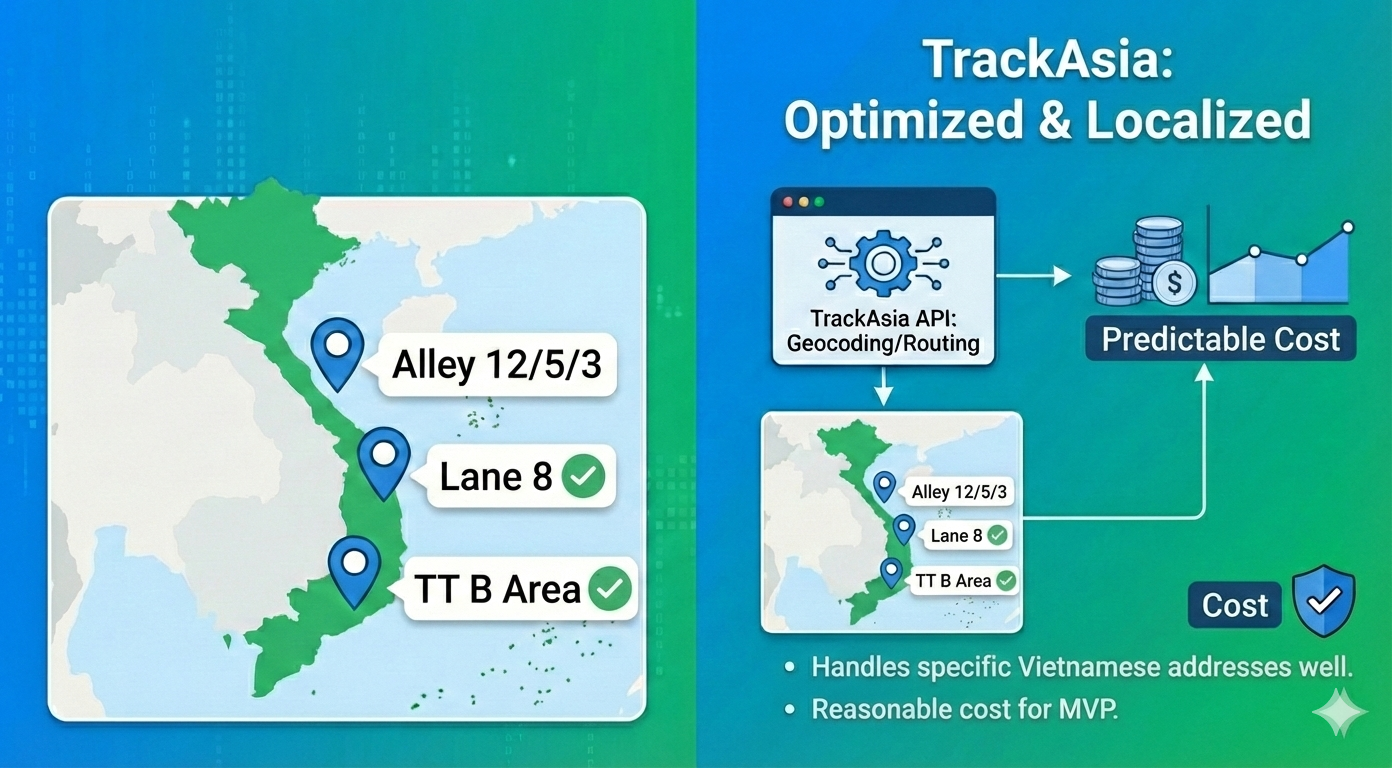
For example, along the same street, addresses deep inside alleys may follow formats like 88/55 or 88/57, while the alley itself may branch and connect to other alleys with different numbering. In such cases, default geocoding results often point to the alley entrance or an incorrect branch.
From the system’s perspective, the address is successfully “resolved.” For delivery drivers, however, this means navigating complex alley networks, backtracking multiple times, or having to contact the customer again.
When these small inaccuracies are repeated at scale, they not only reduce delivery efficiency but also introduce additional steps in automation workflows: address edits, repeated API calls, or manual intervention.
In low-code systems, each such step usually corresponds to another API call. When workflows are duplicated or modified without strict control, request volume can grow rapidly without the team realizing it. The system continues to function, orders continue to flow, but API costs gradually increase and only draw attention once invoices exceed expectations.

At the MVP stage, startups do not need the most “comprehensive” solution. What they need is a tool that is easy to use, easy to deploy, and has minimal operational friction—especially when systems are built on low-code and automation platforms.
For this reason, many Vietnamese startups are beginning to prioritize map solutions designed specifically for the local context, such as TrackAsia, to reduce deployment risk and control costs during the MVP stage—before scaling up or integrating larger global platforms.
Large-scale map platforms offer powerful data and extensive features. However, in low-code environments and during the MVP phase, the decisive factor is not only the “power” of an API, but how well it fits real-world operational workflows.
For Vietnamese startups, choosing a Maps API is not merely a technical decision—it is a strategic decision about resource allocation: from workflow design and API call control to handling local address characteristics. A solution that understands domestic operating conditions can help startups deploy faster, operate more reliably, and avoid hidden costs during the most critical phase of product development.
Moving this industry forward requires not only skill, talent and expertise, but also imagination. From all of us.


 Vietnamese