Yes—if the business treats migration as a controlled process rather than replacing the entire platform at once. The most important work is not changing an API key; it is identifying dependencies, normalizing data, and testing against real operating conditions.
When Map API costs rise, support no longer meets expectations, or a business wants greater control over its data, switching providers becomes an option. Yet many engineering teams delay the decision because mapping is deeply embedded in the product: the UI uses a proprietary SDK, the backend calls several APIs, place data is stored in the old format, and operations depend on familiar results.
That concern is justified. Two providers may both offer basemaps, geocoding, and directions while differing in parameters, response structures, error codes, distance calculations, and data quality. Simply replacing an endpoint and expecting everything to behave as before often produces hard-to-spot errors.
Even so, most businesses do not need to rebuild the entire system. A more practical approach is to break migration down by function, build only the integration layer that is needed, and shift traffic in stages. Stable business processes can remain in place; only components directly tied to the provider need to change.
A Map API migration almost always requires some code changes. The reasonable goal is to limit their scope: preserve order creation, dispatch, pricing, customer management, and other core workflows while replacing or adapting the connection to the mapping service.
If the application already separates mapping from business logic, the work may be confined to a few adapters and UI components. If provider SDK calls are scattered throughout the codebase, the first step is to bring those calls behind a common interface. This is targeted refactoring, not a product rebuild.
The goal of a sound migration: replace the mapping infrastructure while keeping the business behavior that users and operations teams rely on stable.
A common mistake is to inspect only screens that display a map. In a live system, mapping services may appear in many more places: web and mobile applications, the backend, background jobs, data stores, reports, and internal tools.
A basic inventory should cover:
Each dependency should be linked to a particular business workflow. Geocoding used to suggest an address as a customer places an order matters differently from geocoding used to enrich an end-of-day report. That distinction helps set the migration order.
The inventory should also record volume, peak periods, acceptable latency, and ownership. This provides a baseline for comparison instead of judging a new provider by intuition or a handful of sample requests.
Basemaps, geocoding, search, and directions do not have to move together. Treating them as separate workstreams limits the test surface and gives engineers room to resolve issues in each area before moving on.
| Function | Differences to address | How to test in practice |
|---|---|---|
| Map display | SDK, layer types, markers, events, styles, and tile loading. | Compare real screens, zoom and pan behavior, multiple data layers, and performance on lower-end devices. |
| Geocoding | Address structure, precision, result ranking, and classification codes. | Use verified company addresses, including old names, abbreviations, alleys, and incomplete addresses. |
| Place search | Autocomplete, location bias, language, categories, and place IDs. | Measure correct selections, characters typed before useful results appear, and time to complete an entry. |
| Directions and ETA | Vehicle profiles, road restrictions, time-based restrictions, route geometry, and travel-time estimates. | Compare real delivery routes by vehicle type, area, and operating hours. |
| Distance matrix | Waypoint limits, directional differences, timeouts, and handling of unreachable locations. | Run real dispatch batches; measure response time and the effect on assignment decisions. |
There is no fixed migration order. Many businesses start with the basemap because it is easy to inspect and has limited impact on backend logic. If geocoding or routing drives most of the cost, however, that function may come first as long as the scope is controlled.
A small integration layer lets the application exchange mapping data through types the business controls. Instead of having multiple modules parse a provider’s geocoding response directly, for example, the system can normalize only what it needs: coordinates, display address, administrative components, confidence level, and data source.
The layer should handle essential differences in parameter names, response structure, error codes, timeouts, retries, and logging. It should not become a new mapping platform filled with abstractions the business never uses.
Nor should the team assume both providers can return identical results. One may return an address as a single string while another returns separate fields; a provider-specific place ID cannot be reused with another service. Normalize for shared business needs, and isolate and document proprietary features.
Avoid over-standardizing. If the application only needs coordinates, a display address, and a place type, the adapter only needs to guarantee those fields. A focused design is easier to test and maintain.
A demo using a few well-known places cannot establish integration quality. Operational address data in Vietnam often includes old and new street names, changed ward and commune names, abbreviations, alleys, irregular house numbering, locally known place names, and map pins that differ from the formal address.
Build a reference dataset from the company’s own verified orders, delivery points, warehouses, and locations. It should span provinces and cities, urban centers and outlying areas, and include correct, incorrect, incomplete, and ambiguous entries.
An HTTP 200 response is not enough. For search and geocoding, assess correct-match rates, coordinate error, recognition of address components, and the share of entries that staff must correct manually. For routing, check whether directions fit the vehicle type, road restrictions, and real operating practices.
If the system has verified location data, keep it in the company’s own data store where the applicable terms permit, rather than geocoding it again on every request. This lowers cost and limits unintended changes during migration.
After integrating the new provider, the system should go through a parallel-run period. A sample of requests can go to both the old and new services; the new results are logged for comparison but do not yet affect users or business decisions.
This shadow-traffic approach is particularly useful for geocoding, search, and directions. Engineers can track success rates, latency, differences in results, and the query groups with the largest gaps. Sensitive data should be filtered or handled according to the company’s privacy policy before being sent to either service.
For expensive functions, there is no need to duplicate all traffic. A representative sample by area, time of day, vehicle type, and workflow is often more informative than a much larger set of random queries.
Parallel results should be assessed for business impact. A small coordinate difference may be immaterial in a summary report but critical for doorstep delivery. A shorter route is not necessarily better if it sends a truck onto a restricted road.
Once the parallel run meets its acceptance criteria, the business can direct some live traffic to the new provider. The split can be based on percentage, internal user group, geography, application, or a specific function.
Feature flags or routing configuration allow engineers to change traffic shares without redeploying the whole application. Mobile SDKs need a separate backward-compatibility plan because older app versions can remain on users’ devices for a long time.
Rolling back is not always a matter of reverting a configuration value. If data formats have changed, a new app version has shipped, or results from the new provider have been written into the system, the return path may be more involved than expected.
A rollback plan should specify:
The rollback should be rehearsed in a test environment and tried on a small production segment. A plan that exists only on paper still carries substantial risk.
Infrastructure metrics show whether a service is running, but not whether the migration is succeeding. Track three groups of measures together:
| Metric group | Examples to monitor | What it tells you |
|---|---|---|
| Technical performance | p50/p95/p99 latency, timeouts, error rates, quotas, and load handling. | Whether the service meets operational needs, including peak periods. |
| Data quality | Correct-match rate, coordinate error, anomalous routes, and addresses needing manual correction. | Whether the output fits Vietnamese data and operating conditions. |
| Business outcomes | Order creation time, on-time delivery rate, support requests, and cost per transaction. | Whether the technical change is affecting day-to-day operations. |
Not every system can be migrated quickly. The work expands when business logic directly depends on proprietary place IDs; stored data is subject to terms that prevent its use with another service; an SDK appears across many screens; or the current provider’s routes and ETAs have become implicit assumptions in dispatch algorithms.
Specialized features also need separate assessment. Street-level imagery, live traffic, indoor data, visualization tools, or specialized optimization services may have no close equivalent. The business can migrate standard functions first and keep a proprietary feature for a time instead of forcing everything to move together.
Review contracts and data terms early. Caching rights, retention periods, post-termination use of results, and attribution requirements can directly shape the migration design.
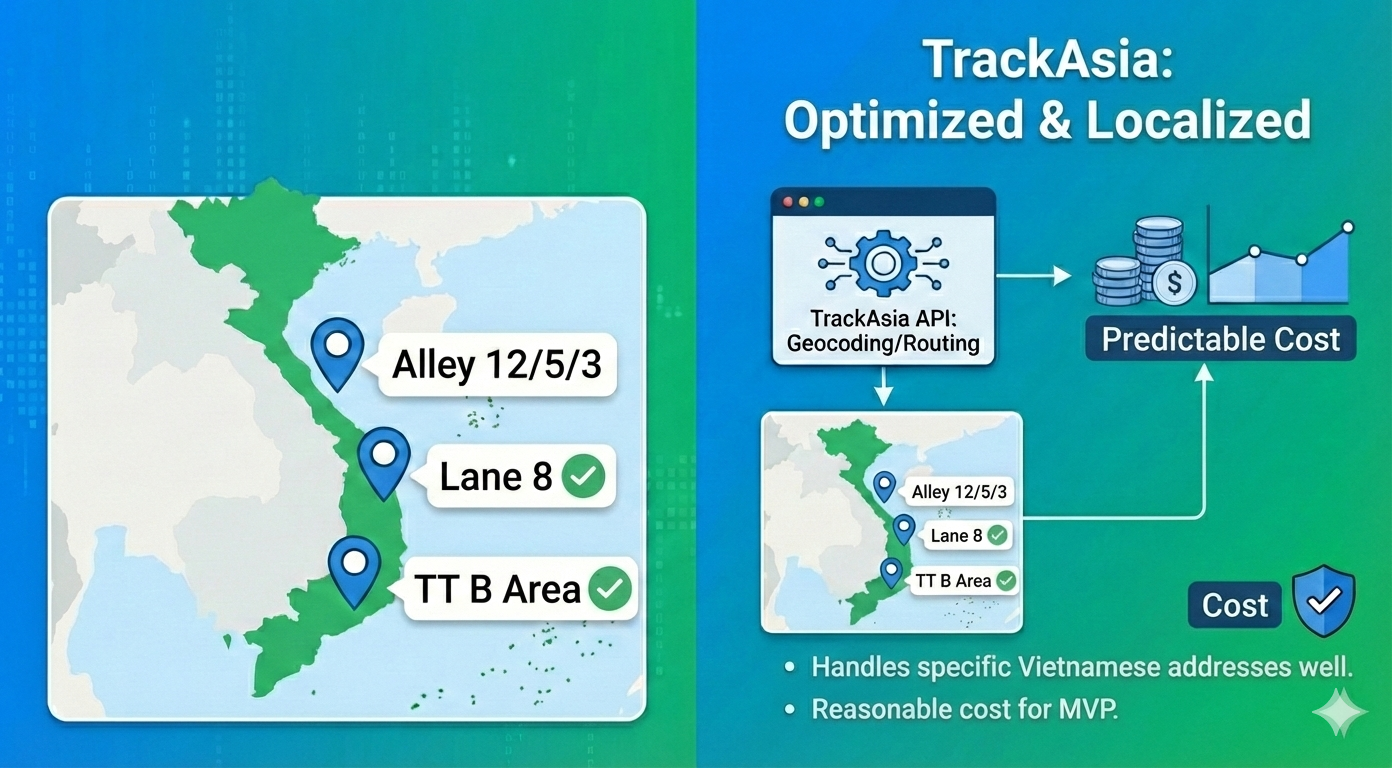
TrackAsia offers basemaps, place search, geocoding, and directions built on open map data for deployments in Vietnam. A business can start with one function or a share of its traffic rather than replacing the entire system at once.
During assessment, engineers can compare results using real addresses and routes, identify where normalization is needed, and then plan a parallel run and controlled traffic shift. This keeps the architecture simple, reduces disruption, and avoids adding an integration layer that is hard to maintain.
Depending on current usage, moving from a proprietary platform to TrackAsia may reduce Map API costs by around 50–70%, while maintaining a 99.9% SLA, reducing infrastructure maintenance work, and giving the business more control over operational data. Actual savings must be validated against each company’s functions, traffic, and quality requirements.
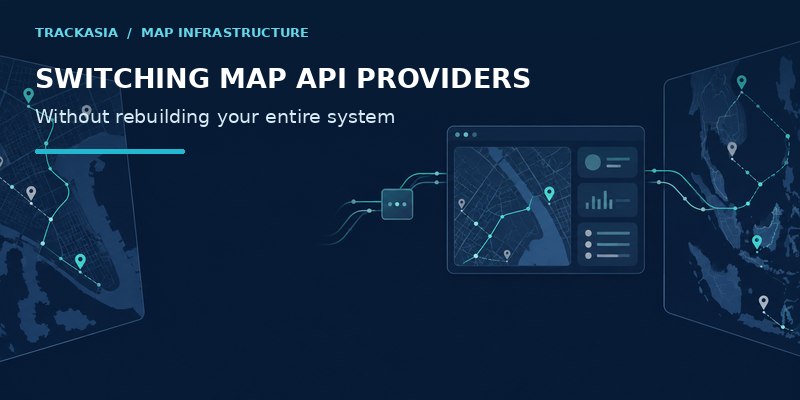
Switching Map API providers without rebuilding the entire system is feasible, but not by changing an endpoint in one step. Businesses need to know where their dependencies lie, migrate by function, normalize only what matters, and test against real operating conditions.
With a parallel-run period, a mechanism for shifting traffic, and a clear rollback path, changing providers becomes a measurable, controlled engineering project. The lasting value is not just one successful migration, but a system that is easier to adapt when the next decision comes.
TrackAsia can work with your engineering team to inventory dependencies, test real addresses and routes, and build a phased migration plan.
TrackAsia — Flexible map infrastructure for businesses in Vietnam.
Moving this industry forward requires not only skill, talent and expertise, but also imagination. From all of us.


 Vietnamese